When a sewer problem is an emergency
A sewer line failure rarely happens quietly. Once the pipe is cracked, collapsed or packed with roots, wastewater has nowhere to go, and the lowest fixture in the house becomes the relief point. We treat active sewage backups as urgent.
- Sewage in a basement drain, tub or toilet.
- Gurgling from fixtures when another fixture drains.
- A sewage smell in the yard or basement, or a soft, sunken patch over the line.
- Repeated main line clogs that clear and return within weeks.
Sewer backup: what to do first
- Stop all water use. No flushing, laundry, dishwasher or showers. Water you add will come back up through the lowest fixture.
- Keep people and pets out. Sewage carries bacteria. Keep children and pets away and wear gloves and boots if you must enter.
- Stay clear of wet electrical areas. If water has reached outlets, a panel or appliances, do not touch them. Turn off the breaker only from a dry spot.
- Take photographs. Photograph the affected area for your insurance claim before cleanup starts.
- Call us. A technician can clear the line and run a camera to find out why it failed.
Why Plainfield sewer laterals fail
The lateral is the pipe that carries wastewater from your house to the sewer main. In older Plainfield neighborhoods, laterals are often clay or cast iron installed generations ago. Clay joints loosen and let roots in, and cast iron corrodes from the inside until the wall thins or flakes.
Plainfield's older sections also have mature street trees and large lots, which makes root intrusion common. Ground that has shifted after heavy storms can also offset a joint or crush a pipe, leaving a belly where water and solids collect.
Wastewater from the city flows to the Plainfield Area Regional Sewerage Authority, which serves eight municipalities including Plainfield, North Plainfield and Scotch Plains. The pipe from your house to the main is generally the homeowner's responsibility to maintain, so ask your municipality where ownership changes at your address.
Diagnosis comes first
We do not recommend a repair until we have seen the pipe. A sewer camera runs through the line and records the roots, cracks, offset joints and low spots, and it measures how far from the cleanout each problem sits. That recording decides between a small repair and a longer one.
If the line is clogged first, we clear it with a cable or hydro jetting, then scope it. Scoping a line that is still full of water and debris shows very little, so the order matters. See sewer camera inspection for what the recording includes.
Repair options compared
| Option | Best when | Trade-off |
|---|---|---|
| Spot repair (dig and replace a section). | One short bad section, easy to reach. | Requires excavation over that section. |
| Pipe lining (cured-in-place). | Cracks, small offsets or root-prone joints in a long run. | Needs a clear, round pipe, and a collapsed section may rule it out. |
| Pipe bursting. | A long run of failed pipe with access at both ends. | Digs entry and exit pits, with less trenching in between. |
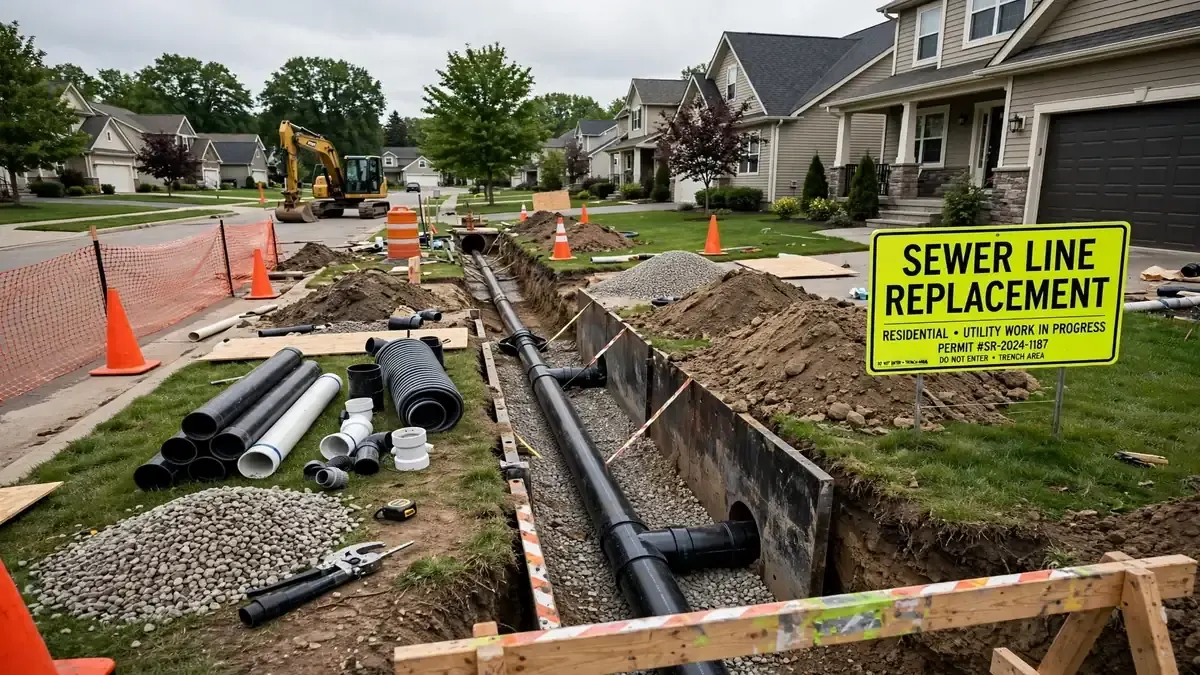
| Full replacement by trench. | Collapsed pipe, severe belly, or a mix of pipe materials. | Most disruptive to a lawn, driveway or sidewalk. |
No option is best for every house. We explain which ones your camera recording supports and what each one disturbs. Our sewer line cleaning page covers the routine side, and a lined or replaced pipe lowers the chance of a repeat backup.
Cast iron and clay: what we look for
Cast iron fails from the inside, and the pipe can look sound from the outside until it breaks. We look for flaking scale, thinned walls and cracks along the bottom of the pipe. Clay fails at the joints, so we look for root hairs and offset hubs.
If you see cast iron under the slab, a short lining sleeve can sometimes seal a crack without breaking the floor. Whether that is realistic depends on pipe diameter, bends and fittings. We tell you honestly when a spot lining will not hold.
Permits and inspections
Work on a sewer line is regulated. The Plainfield Construction Division enforces the state Uniform Construction Code, and the City's homeowner manual says to call the Building Department at 908-226-2665 to confirm whether a permit applies. Permit rules vary by the type of work, so ask before you hire anyone for excavation or replacement.
You can also check any plumber's license with the New Jersey State Board of Examiners of Master Plumbers, which is part of the state Division of Consumer Affairs.
What affects the price of sewer line repair
- Length and depth.A short repair near the cleanout costs less than a long run under a driveway.
- Repair method.Spot repair, lining, bursting and trench replacement are priced very differently.
- Surface restoration.Lawn, sidewalk, driveway and landscaping repairs add cost on top of the pipe work.
- Pipe condition.A mix of cast iron, clay and plastic may call for more fittings and time.
- Permits.Some work requires a permit and an inspection, and that adds scheduling time.
Sewer backup is often excluded from standard homeowner policies unless you added backup coverage. Ask your carrier. Call (908) 357-1542 for your real number.
Sewage backing up?
Tell us which fixtures are affected. We will clear the line and show you the camera recording before recommending any repair.
Where we repair sewer lines
We work across Plainfield, including the 07060, 07062 and 07063 ZIP codes, and in Scotch Plains and Piscataway. A first backup in an older house is often a warning, and a camera look is the cheapest way to learn the real condition of the pipe.
Sewer line repair questions
Yes. Dispatch is open 24/7, and an active sewage backup is treated as an emergency. We book same-day visits when a technician is available. Call (908) 357-1542.
A clog clears and stays clear. A cracked or rooted line clogs again within weeks. A camera inspection shows which one you have.
The lateral from your house to the main is generally the homeowner's. Ask your municipality where ownership changes at your address before you plan work.
Sometimes. Lining and pipe bursting reduce digging, but they depend on the pipe's condition and layout. A camera recording shows what is possible.
Roots seek out joints and cracks. A repaired or lined pipe has fewer openings, so regrowth is less likely, but a tree near the line can still be a problem.
Permit rules vary by the type of work. The City's manual says to call the Building Department at 908-226-2665, and the Plainfield Construction Division enforces the state code.